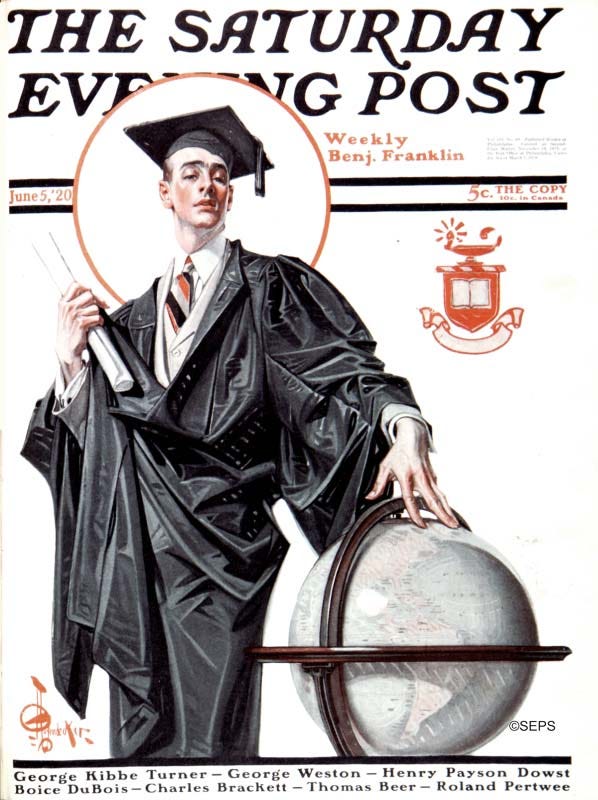
As someone who follows economic and financial market news a little more closely than most people, I continue to be impressed by a few statistics that run counter the popular opinion of many major news outlets. The unemployment rate in America hovers near 50 year lows, stock market indexes continue to push record highs, and corporate America is expanding their hiring budgets for young talent.
That last item is according to Auren Hoffman, CEO of Flex Capital, but it seems to make little sense when you consider the real crisis that pervades America’s universities: corrupt admissions processes, corrupt grading standards, and corrupt curriculum objectives. That last item may apply more heavily to the humanities department and not physical sciences, but it does infect the economic concepts taught to business school students.

In other words, there should be a shortage of young talent graduating from American universities with the cognitive skills, technical knowledge and desire to create value for their employers, customers and colleagues. Why? As Stanford University humanities professor, author and Senior Fellow at the Hoover Institution, Victor David Hanson tells it:
Lower academic standards at top schools are to accommodate lower admissions standards for biologic and nationality quotas.
Politicized coursework by politicized professors who remove empirical knowledge and inductive reasoning skills for a predetermined social agenda.
Therapeutic courses to mitigate the weak preparatory skills of students admitted under DEI mandates.
Racial essentialism for the even distribution of A and A- grades.
Curriculum for non-rigorous social “studies” to help justify grade inflation for weak students
Safe spaces, trigger warnings and separate graduations are used to rationalize the 3.8 grade point averages, lower admission standards, politicized coursework, politicized professors, therapeutic courses, racial essentialism, and “studies” programs.
The good news is that employment rates and stock market indexes are at record levels because the American economy continues to create wealth. In turn, there is opportunity and cash flow for a record number of students and their parents to willfully fund these indoctrination camps.
The bad news is that recent graduates who are complaining about the lack of career opportunities do not understand the nature of the problem. It is not the American economy or culture. All of us born here have hit life’s lottery. They have gotten bad advice. Some have adopted bad habits or the wrong attitude. The ones who get it, get it. And get ahead.

The Hiring Manager
During my brief career in management with a major Wall Street firm, my responsibilities included the fulfillment of my firm’s own hiring quotas. We were in growth mode and the hiring and training of retail Financial Advisors was a priority. The romanticism of high finance and fast markets was certainly an attraction, but like any professional who is starting fresh, it’s about new client relationships. It’s about marketing your knowledge and integrity in a competitive industry.
What I was looking for were energetic people with communication skills who understood the power of our premier global brand. One primary source was college Career Fairs for graduating seniors - and the other was newspaper advertising for more mature, career changing professionals. For the latter, we invited them to our bi-monthly Career Night presentation in the branch office.
And whether it was Career Fair or Career Night, each candidate completed a multiple-choice psychological test to help uncover their entrepreneurial talents or lack thereof. Again, it was about marketing in a competitive industry, but none of it was reliable.
To me, career fairs were both tedious and fun. The college seniors had instructions to show up in professional dress and do their homework about the companies to whom they wanted to speak. Naturally, I attracted business school students, but many of those who approached me only asked about information technology job openings. We had big IT departments, but in home office locations for which I was not recruiting.
Inevitably, a few would visit my table and ask, “What do you guys do?” My pat answer was, “We are one of the largest and most famous investment banks in the history of the world.” That was always fun. And I got hundreds of resumes from the classified ads that were interesting. For employment history, one young lady wrote of her current job description: “first point of contact in the customer interface structure.” That was rich. A really good receptionist is of great value and I had to find out.
So, what is the point of all this? Auren Hoffman’s recent comments on Substack about hiring young talent in today’s economy - 25 years later than my narrative above, has not changed. Some things never change:
You have to show you can add value. That is it. That is the only thing. The test the smart hiring manager applies in 2026 is simple. Can you learn something on your own? Can you finish what you started? Can you do what you said you would do? These were always the skills that mattered.
From assistant Branch Manager to Branch Sales Manager to Area Training Manager, I interviewed and hired hundreds of people into our Financial Advisor training program and terminated almost all of them. A few have had marvelous careers. Ultimately, everyone has to become profitable at some point and the metrics for that were objective: revenue. Cash flow is the electrical current of civilized cultures and profitable businesses, but I repeat myself.
Yet, all of us were operating on a flawed system. The advisor training was focused on traditional best practices of the industry - which differentiates no one and is loaded with contradictions. Those were a confusing array of packaged products supported by economic forecasts and arbitrary performance benchmarks - and most candidates were not going to do what they said they would do anyway.

The Builder’s Mindset
At this point you can see there is a wide philosophical gap separating the application, admissions and career development of college students at American universities and the application, admissions and career advancement for college graduates in corporate America.
Of course, there is the profit incentive, but Affirmative Action had been a guiding force for years in the private sector. This divide grew wider with the election of Barry Obama in 2008, but according to Hoffman, being a graduate of one of the top schools used to mean something:
They hired the Penn graduate because the admissions filter at Penn was strong. You went there, so you were probably smart and probably hard-working. The school did the screening for the company.
In the university environment described by Hanson, the effort of mental focus and thinking long-term is inherently bigoted. Furthermore, no one should get ahead if their ideas and actions were determined by genetics and societal forces. Instead, your initiative and low time preference is of no credit to you, but if you are allowed to excel, your effort imposes a duty on you to “give back.” You must sacrifice what you mistakenly believe you have earned. After all, “you didn’t build that.”
Fortunately, the DEI mindset of State funded institutions and corporate HR departments is finally being exposed to the harsh light of reality. But like all worthy progress, it must be replaced in the hearts and minds of the individual looking for a purposeful career and meaningful life, and Hoffman nails it:
The trait that predicts whether someone gets hired and stays hired in 2026 is not pedigree, technical skill, or raw IQ. it is whether you do what you said you would do. Nobody is asking for genius. they are asking for FOLLOW-THROUGH. The rare person who reliably does the thing they committed to is the most valuable employee in any company in any role.

How do I know? In 2008 and with a 20 year career in retail brokerage and investment management, my position was being eliminated and I was pounding the pavement. I had also relocated to a different branch in a new location and did not know anyone outside of my firm and my family.
But I had two things going for me. I had taken leadership roles with the local Chamber of Commerce and I had become certified in the discipline of statistical analysis for objective investing. I then contacted everyone I knew to let them know of my transition before they heard about it from third parties.
One of them told me about an opportunity with the trust department of her employer. I was then introduced to the team leader, who arranged an interview with the regional manager, and then with the senior wealth executive. All of them heard the same story: I was committed to the fiduciary methods that were most valuable to a trust department, and I had been selected for the city’s Men’s 8 crew competing in the Head of the Charles regatta in Boston.
Then the team leader called someone from the Chamber board of directors who worked at the bank and asked if he knew me. The response was “hire Mark, he does what he says he will do.” Bear in mind, this was the fall of 2008 and the worst time imaginable to be looking for a new career opportunity in the investment management industry. But that was me, what does Hoffman suggest for you?
The most valuable thing a 22 year old can do in 2026 is create something. An app. A screenplay. A side business. An internal tool you wrote for a club you were in. The point is that you taught yourself something. You finished it. You can describe what you learned, what broke, what you fixed, why you made the calls you made. That story is the new resume.